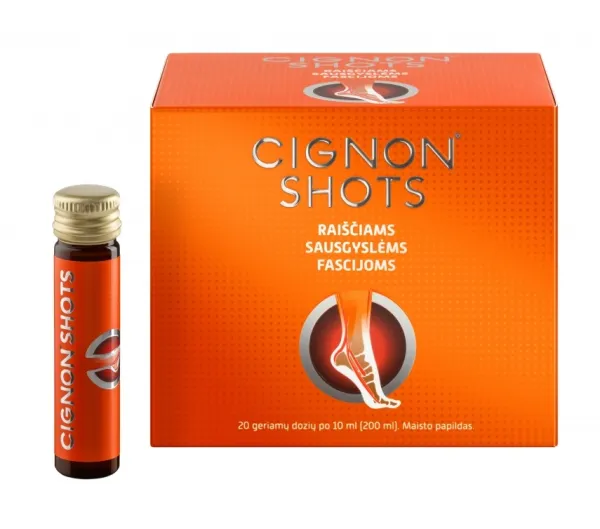
CIGNON SHOTS Maisto papildas N20RAIŠČIAMSSAUSGYSLĖMSFASCIJOMSRaiščiai, sausgyslės, fascijos yra judėjimui būtini jungiamojo audinio dariniai:
raiščiai lyg virvės suriša sąnariuose esančius kaulų galus ir garantuoja judesio tikslumą;
sausgyslėmis raumenys jungiasi prie kaulų. Joms susitraukiant pritraukiami kaulai ir taip įvyksta judesys;
ascijos lyg tinklas apsupa ir sujungia kaulus, raumenis, sąnarius, raiščius, sausgysles į visumą, padeda raumenims sąveikauti tarpusavyje atliekant judesius.
| 10 ml | RMV* | |
Mukopolisacharidai:
| 415 mg25 mg | - |
Dažinių ciberžolių šaknų skystasis ekstraktas, kuriame
| 100 mg5 mg | - |
| Hidrolizuotas kolagenas | 80 mg | - |
| Cinkas | 1,5 mg | 15 % |
| Varis | 0,15 mg | 15 % |
Kannus P. Structure of the tendon connective tissue. Scand J Med Sci Sports 2000: 10: 312–320.
Benjamin M, Kaiser E, Milz S. Structure-function relationships in tendons: a review. J. Anat. 2008: 212, 211–228.
Sharma P, Maffulli N. Biology of tendon injury: healing, modeling and remodeling. J Musculoskelet Neuronal Interact 2006; 6(2):181-190
Scientific Opinion on the substantiation of health claims related to copper and protection of DNA, proteins and lipids from oxidative damage (ID 263, 1726), function of the immune system (ID 264), maintenance of connective tissues (ID 265, 271, 1722), energy-yielding metabolism (ID 266), function of the nervous system (ID 267), maintenance of skin and hair pigmentation (ID 268, 1724), iron transport (ID 269, 270, 1727), cholesterol metabolism (ID 369), and glucose metabolism (ID 369) pursuant to Article 13(1) of Regulation (EC) No 1924/2006. EFSA Journal 2009;7(9):1211.
Oxidative stress. (2017, October 1). In Wikipedia, The Free Encyclopedia.
Scientific Opinion on the substantiation of health claims related to zinc and maintenance of normal skin (ID 293), DNA synthesis and cell division (ID 293), contribution to normal protein synthesis (ID 293, 4293), maintenance of normal serum testosterone concentrations (ID 301), “normal growth” (ID 303), reduction of tiredness and fatigue (ID 304), contribution to normal carbohydrate metabolism (ID 382), maintenance of normal hair (ID 412), maintenance of normal nails (ID 412) and contribution to normal macronutrient metabolism (ID 2890) pursuant to Article 13(1) of Regulation (EC) No 1924/2006. EFSA Journal 2010;8(10):1819.
Scientific Opinion on the substantiation of health claims related to zinc and function of the immune system (ID 291, 1757), DNA synthesis and cell division (ID 292, 1759), protection of DNA, proteins and lipids from oxidative damage (ID 294, 1758), maintenance of bone (ID 295, 1756), cognitive function (ID 296), fertility and reproduction (ID 297, 300), reproductive development (ID 298), muscle function (ID 299), metabolism of fatty acids (ID 302), maintenance of joints (ID 305), function of the heart and blood vessels (ID 306), prostate function (ID 307), thyroid function (ID 308), acid-base metabolism (ID 360), vitamin A metabolism (ID 361) and maintenance of vision (ID 361) pursuant to Article 13(1) of Regulation (EC) No 1924/2006. EFSA Journal 2009;7(9):1229.
Järvinen M, Józsa L, Kannus P, Järvinen TL, Kvist M, Leadbetter W. Histopathological findings in chronic tendon disorders. Scand J Med Sci Sports. 1997 Apr;7(2):86-95.
Benjamin M. The fascia of the limbs and back–a review. Journal of anatomy. 2009, 214(1), 1-18.
Benjamin M, Ralphs JR. Tendons and ligaments-an overview. Histology and histopathology 1997; 12(4), 1135-1144.
Findley TW, Shalwala M. Fascia research congress evidence from the 100 year perspective of Andrew Taylor still. Journal of Bodywork and Movement Therapies, 2013, 17(3), 356-364.
Paoletti S. Fascia (pp. 142-145). Munich Germany: Urban & Fischer Verlag. 2001.
Stecco C, Macchi V, Porzionato A, Duparc F, De Caro R. The fascia: the forgotten structure. Italian journal of anatomy and embryology. 2011, 116(3), 127-138.